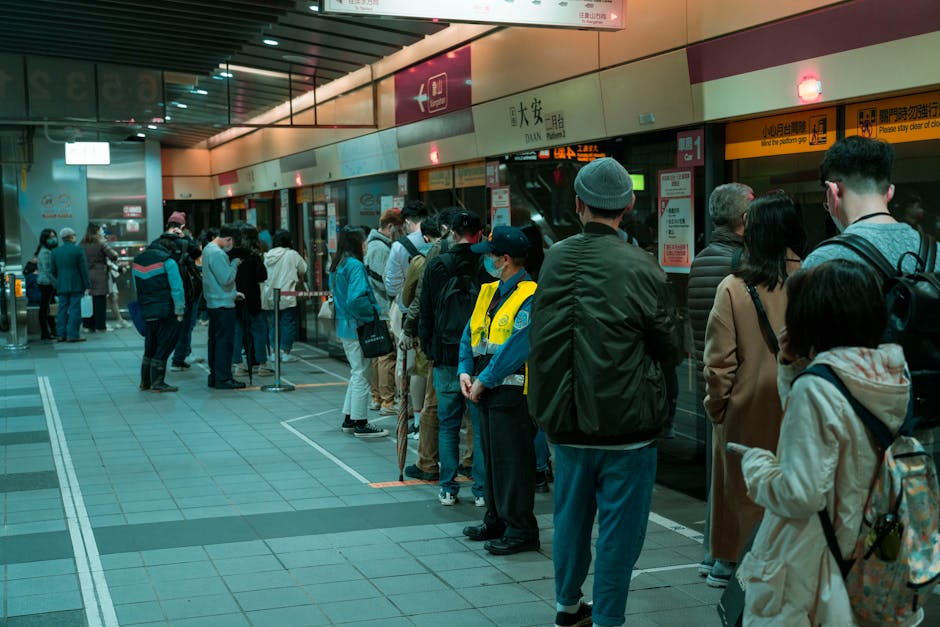
Why do crowd dynamics matter for public health?
When large groups gather in confined spaces—airports, train stations, stadiums, or shopping malls—the way people move and wait can affect the spread of infectious diseases. Close contact, shared air, and prolonged exposure create conditions where viruses or bacteria can pass from one person to another. Public‑health officials therefore treat crowd management, queue design, and passenger‑flow planning as tools for disease prevention, not just for convenience.
Key concepts explained
Crowd density
Density measures how many individuals occupy a given area, usually expressed as persons per square metre. A density of 1 person / m² allows easy movement; 2–3 persons / m² starts to restrict personal space; above 4 persons / m² people are forced into close contact. Research shows that respiratory droplets travel farther when people are tightly packed, raising transmission risk.
Queue length and waiting time
Long queues extend the time each person spends in a shared environment. If the air is poorly ventilated, viral particles can accumulate, making every additional minute a potential exposure. Queue length also influences stress levels, which can weaken immune response.
Passenger flow rate
Flow rate is the number of people passing a point per unit time (e.g., passengers per minute through a security checkpoint). A high flow rate reduces dwell time but may increase density at bottlenecks. Balancing speed and spacing is the core challenge.
How diseases spread in crowded settings
Three main pathways dominate:
- Droplet transmission: Large droplets fall within 1–2 m of the source. In dense queues, many people fall inside that radius.
- Aerosol transmission: Small particles stay suspended for minutes and can travel with air currents. Poor ventilation amplifies this risk.
- Fomite transmission: Touching shared surfaces—handrails, ticket machines, door handles—can transfer pathogens. High‑traffic zones see frequent surface contact.
Understanding these pathways helps planners choose which interventions will have the greatest impact.
Design principles for safer crowds
Physical distancing measures
Markings on the floor, barriers, and signage can enforce a minimum distance of 1–2 m between waiting individuals. When space permits, staggered lines (e.g., a zig‑zag pattern) keep the flow smooth while preserving distance.
Ventilation and air filtration
Increasing fresh‑air intake and using HEPA filters lower aerosol concentration. Simple actions—opening doors, using portable air cleaners, or scheduling regular HVAC maintenance—are often more cost‑effective than structural redesign.
Queue segmentation
Dividing a long line into shorter, parallel queues reduces overall density. Each segment can have its own service point or be timed to release groups at set intervals. Segmentation also simplifies contact‑tracing if an outbreak occurs.
Speed‑up technologies
Contactless ticketing, biometric scanners, and automated baggage drops cut the time each passenger spends at a checkpoint. Faster processing reduces dwell time, lowering cumulative exposure.
Practical steps for different venues
Airports and airline hubs
Air travel involves multiple stages—check‑in, security, boarding, and baggage claim—each creating a potential bottleneck.
- Pre‑screening: Encourage online check‑in and document upload to skip counters.
- Security lanes: Use multiple parallel lanes with clear floor markings. Deploy lane‑splitting barriers that direct travelers into a single file while allowing space for luggage.
- Boarding gates: Adopt staggered boarding groups (e.g., by seat row or zone) and display real‑time queue length on screens.
- Post‑arrival: Separate arrivals by destination—domestic vs. international—to keep cross‑traffic low.
Rail and subway stations
High‑frequency services mean passengers spend only minutes on platforms, but peak hour crowds can exceed safe density.
- Platform markings: Paint “waiting zones” that keep riders away from train doors until a train stops.
- Timed entry: Use turnstiles that limit the number of people entering a platform per minute.
- Escalator management: Assign one side for standing and the other for walking to prevent bottlenecks at the base.
Event venues and stadiums
Large gatherings are high‑risk by nature. Planning must start months ahead.
- Ticket allocation: Limit total capacity to a level that allows 1 m² per person.
- Ingress routing: Direct attendees through multiple entry points, each with its own security and health‑screening checkpoint.
- In‑venue circulation: Use wide aisles, avoid dead‑end corridors, and provide clear signage for exits.
- Post‑event dispersal: Stagger exit times by seat zone and coordinate with public transport to avoid rush‑hour spikes.
Balancing efficiency and safety
Operators often fear that safety measures will slow operations and hurt revenue. Data from several transport authorities show that modest changes—adding an extra turnstile, widening a queue lane, or improving signage—can increase throughput by 10–15 % while keeping density below critical thresholds. The key is to treat crowd control as a flow‑optimization problem rather than a static space allocation.
Tools and technologies for monitoring
Modern venues use a mix of hardware and software to track crowd behavior in real time.
People‑count sensors
Infrared beams, video analytics, and pressure‑sensitive mats count individuals entering and exiting a zone. When counts approach a preset limit, alerts can trigger staff to open additional lanes or pause entry.
Heat‑mapping and density analysis
Overhead cameras combined with AI can generate heat maps that highlight crowded spots. Managers can respond instantly—by redirecting traffic or deploying staff to enforce distancing.
Mobile‑app integration
Travel apps can push real‑time crowd‑level information to passengers, encouraging them to choose less‑busy times or alternative routes.
Policy frameworks and standards
Many countries have adopted guidelines that embed crowd‑management into public‑health policy.
- World Health Organization (WHO) recommendations: Emphasize ventilation, physical distancing, and surface hygiene in mass‑gathering settings.
- International Organization for Standardization (ISO) 19011: Provides audit guidelines that can be adapted to evaluate crowd‑control procedures.
- National fire codes: Often include maximum occupancy limits, which can double as public‑health caps during epidemics.
Compliance with these frameworks not only reduces disease risk but also helps venues avoid legal liability.
Training staff for health‑focused crowd management
Human factors are decisive. Even the best-designed space fails if staff do not enforce protocols.
- Clear instructions: Use simple language and visual cues; avoid technical jargon.
- Role‑playing drills: Simulate peak‑hour scenarios and practice opening/closing lanes, redirecting flow, and handling non‑compliant passengers.
- Health‑screening awareness: Teach staff to recognize signs of illness and to refer individuals to medical triage points without causing panic.
Evaluating effectiveness after implementation
Measurement should be ongoing, not a one‑off audit.
- Key performance indicators (KPIs): Average dwell time, maximum density reached, number of crowd‑related incidents, and compliance rates with distancing markers.
- Post‑event reviews: Compare KPI data with baseline figures from before the changes.
- Feedback loops: Collect passenger surveys on perceived safety and comfort; use insights to fine‑tune signage or staffing levels.
Common pitfalls and how to avoid them
Even experienced operators can stumble.
- Over‑reliance on signage alone: Signs are helpful, but without active staff enforcement crowds quickly revert to old habits.
- Neglecting ventilation in favor of physical barriers: Barriers block droplets but do nothing for aerosols; pair them with fresh‑air solutions.
- Under‑estimating peak‑hour spikes: Use historical passenger data to model worst‑case scenarios; design for the top 5 % of traffic rather than the average.
- Ignoring the psychological aspect: People feel uneasy when they perceive a threat. Transparent communication about measures builds cooperation.
Future directions without speculation
Current research focuses on integrating crowd‑flow models with epidemiological simulations. By feeding real‑time density data into disease‑spread models, planners can predict outbreak hotspots before they emerge. Investment in modular barrier systems and rapid‑deployment ventilation units makes it possible to adapt existing spaces quickly when a new health threat appears.
