What does ventilation mean for a transport hub?
In a railway station or an airport terminal, ventilation is the system of moving fresh air into the building, removing stale or contaminated air, and distributing the filtered mix where it is needed. It is not a single piece of equipment but a network of fans, ducts, filters, control panels and sensors that work together to keep the indoor environment safe and comfortable.
Why has airflow become a critical issue now?
Several recent developments have shifted the balance of risk and expectation:
- Health concerns. The COVID‑19 pandemic highlighted how airborne particles can travel long distances in crowded spaces. Operators now demand measurable reductions in aerosol concentration.
- Higher passenger volumes. Urbanisation and rising air‑travel rates mean more people share the same air at any moment, increasing the load on any ventilation system.
- Regulatory pressure. Agencies such as the U.S. Environmental Protection Agency (EPA), European Union’s EN 15251, and local building codes have tightened airflow and indoor‑air‑quality (IAQ) requirements for public buildings.
- Energy sustainability goals. Modern hubs aim to cut carbon footprints. Balancing fresh‑air intake with heating, cooling and electricity use is a complex optimisation problem.
Key performance goals of a station ventilation system
Operators typically evaluate a system against three measurable targets:
| Goal | What it means | Typical metric |
|---|---|---|
| Air Quality | Removal of pollutants, pathogens and odors | PM2.5, CO₂, VOC levels |
| Thermal Comfort | Maintain temperature and humidity within comfort bands | ΔT ± 2 °C, RH 30‑60 % |
| Energy Efficiency | Provide the above with minimal energy use | EER, kWh/m³ of air |
How airflow affects passenger health
When a person breathes, speaks or coughs, they release droplets that quickly evaporate into aerosol particles. In a confined space with poor mixing, these particles can linger for many minutes, raising the risk of inhalation by others. Proper ventilation reduces that risk in two ways:
- Dilution. Fresh air replaces a portion of the indoor air, lowering the concentration of any contaminant.
- Filtration and disinfection. High‑efficiency filters (e.g., MERV 13‑16 or HEPA) capture particles; some systems add UV‑C light to inactivate viruses.
Studies in similar environments – schools, offices and retail stores – show that increasing the outdoor‑air‑changes‑per‑hour (ACH) from 2 to 6 can cut aerosol exposure by about 50 % under comparable occupancy.
Design considerations unique to stations and terminals
Variable passenger density
Peak commuter periods can push passenger density to 8–10 persons per square metre, while off‑peak times may see less than 1 person per square metre. A good ventilation strategy uses sensors (CO₂, occupancy counters) to adjust fan speeds in real time, rather than running at a constant rate.
Large open volumes
Platforms, concourses and baggage halls are often vaulted spaces with high ceilings. Simple mixing fans may not reach the farthest corners, so designers add displacement ventilation or high‑placed supply diffusers that push air downwards, creating a more uniform flow.
Interaction with other building systems
Heating, ventilation and air‑conditioning (HVAC) must coordinate with fire‑smoke extraction, escalator exhaust and even the train‑induced slipstream that can push air along the platform. Integrated control platforms allow a fire alarm to override normal ventilation, ensuring smoke is exhausted quickly while still providing fresh air for evacuation routes.
External environmental factors
Stations located in coastal or industrial regions may have to filter salt or particulate matter. Airports often sit on large parcels of land where wind direction changes seasonally; designers incorporate adaptable intakes that can be closed during high‑pollution events.
Core components of a modern ventilation system
- Air handling units (AHUs). Centralised plants that condition and filter incoming air. Modern AHUs use variable‑frequency drives (VFDs) to match airflow to demand.
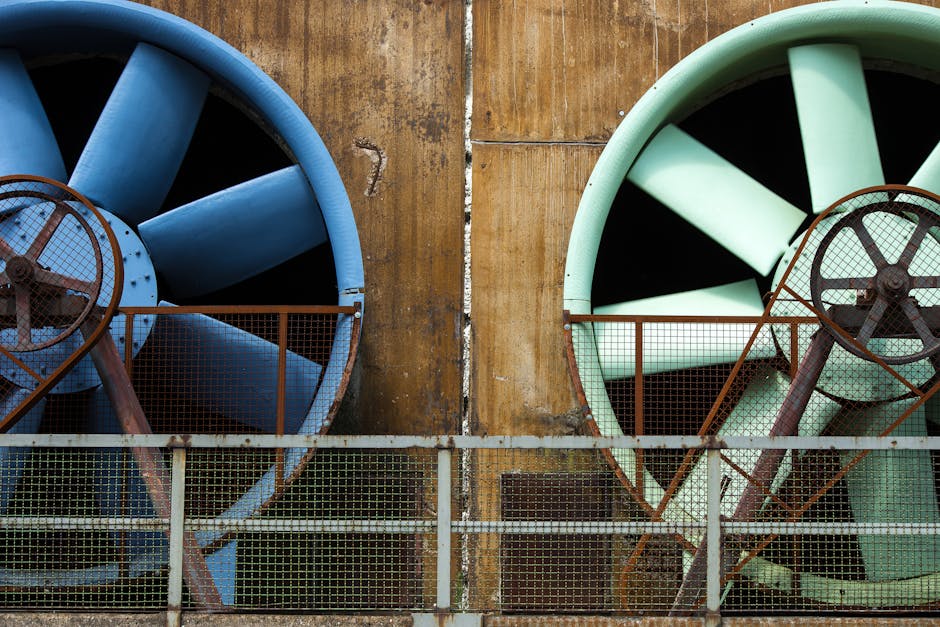
- Fans and blowers. Often arranged in series (supply and exhaust) to create a pressurised environment that prevents infiltration of unconditioned air.
- Filters. Pre‑filters capture large debris; secondary filters (MERV‑13 to HEPA) trap fine particles and pathogens.
- Ductwork. Designed to minimise pressure losses; smooth interiors and properly sized bends reduce energy consumption.
- Controls and sensors. CO₂, temperature, humidity and particulate sensors feed data to a building‑management system (BMS) that modulates fan speeds and damper positions.
- Supplementary devices. UV‑C lamps, bipolar ionisers or portable air cleaners can add a layer of disinfection when required.
Balancing air quality with energy consumption
Increasing outdoor air improves IAQ but also raises heating or cooling loads. Engineers use several tactics to keep energy use in check:
- Heat recovery ventilators (HRVs) or energy recovery ventilators (ERVs). They transfer thermal energy from exhaust air to incoming fresh air, saving 40‑70 % of heating or cooling energy.
- Demand‑controlled ventilation (DCV). Sensors trigger higher airflow only when CO₂ exceeds a set threshold (often 800 ppm). Between rush hours, the system can drop to a low baseline.
- Zonal control. Separate ventilation loops for high‑traffic zones (platforms, boarding gates) and low‑traffic spaces (offices, retail) allow tailored airflow rates.
- Smart scheduling. Pre‑conditioning air during off‑peak periods when electricity rates are lower, then using stored thermal energy during peaks.
Case study: Retrofitting ventilation at a busy commuter rail hub
A European city upgraded the ventilation at its central station, which serves 250,000 passengers daily. The existing system ran at a fixed 3 ACH, regardless of load, and used basic panel filters (MERV 8). The retrofit involved:
- Installing new AHUs with VFD‑controlled fans and ERV units.
- Replacing filters with MERV 13 media and adding optional UV‑C modules.
- Deploying a network of CO₂ and particle sensors on each platform.
- Integrating the sensors with the station’s BMS to enable DCV.
- Adding high‑placement supply diffusers to improve mixing on the platform level.
Post‑implementation measurements showed a reduction in average CO₂ from 1,200 ppm to 650 ppm during peak periods, a 35 % drop in heating energy, and a measurable decrease in reported passenger discomfort.
Regulatory frameworks that guide design
Designers must align with several standards, depending on geography:
- ASHRAE 62.1. Sets minimum ventilation rates for indoor spaces in the United States.
- EN 15251. European standard for indoor environmental parameters, including ACH and thermal comfort.
- ISO 16890. Provides a performance‑based classification for air filters, useful when specifying filtration levels.
- Local building codes. Many cities now require a minimum of 6 ACH in high‑occupancy transport facilities.
Emerging technologies that could shape future airflow strategies
While the core principles of ventilation remain unchanged, new tools help operators respond faster and more precisely:
- AI‑driven predictive control. Machine‑learning models forecast passenger volumes based on timetable data and adjust ventilation proactively.
- IoT‑enabled sensors. Low‑power, networked devices supply real‑time IAQ data to a cloud dashboard, enabling remote monitoring.
- Hybrid natural‑mechanical ventilation. In temperate climates, operable louvers allow ambient wind to assist mechanical fans, cutting energy use.
- Modular portable units. During events or construction, portable HEPA‑filtered air movers can supplement permanent systems quickly.
Maintenance practices that keep airflow reliable
Even the best‑designed system loses effectiveness if filters clog or fans wear out. A disciplined maintenance program includes:
- Filter inspection. Visual checks weekly; replace or clean according to manufacturer‑specified pressure‑drop limits.
- Fan performance testing. Measure airflow and motor current monthly; look for degradation beyond 10 %.
- Duct cleaning. Conducted every 3–5 years, or after construction work, to remove dust accumulation that can block flow.
- Sensor calibration. CO₂ and particulate sensors should be calibrated annually to avoid drift.
- Control‑system audit. Verify that BMS logic matches current occupancy patterns; update setpoints as passenger trends evolve.
What should operators evaluate when choosing a ventilation solution?
Decision‑makers need to weigh several factors beyond initial cost:
- Scalability. Can the system handle future passenger growth without major redesign?
- Resilience. Does the design allow continued operation during power outages or extreme weather?
- Compatibility. Will new equipment integrate with existing BMS protocols (e.g., BACnet, Modbus)?
- Lifecycle cost. Energy consumption, filter replacement and maintenance should be modelled over a 20‑year horizon.
- Regulatory compliance. Verify that the solution meets current local codes and can adapt to foreseeable tightening of standards.
Key take‑aways for station and terminal managers
Airflow in transport hubs is a safety issue, a comfort factor, and an energy cost centre all at once. Understanding the interplay between passenger density, system design, and real‑time controls allows operators to keep IAQ high while controlling expenses. Regular maintenance, adherence to standards, and openness to emerging technologies keep a ventilation strategy effective as conditions evolve.
